When readers type Italian love stories into a search box, they are rarely asking for a podium of famous couples. They are trying to name a climate: two people learning each other while a working Italian town keeps its shutters, scooters, and market hours. Autocomplete does not know that. It will offer opera summaries, family sagas, crime romance, Tuscan villa memoirs, and contemporary travel novels as if those hungers shared a spine. They do not. This essay walks that hallway and names the doors—without ranking other people’s books.
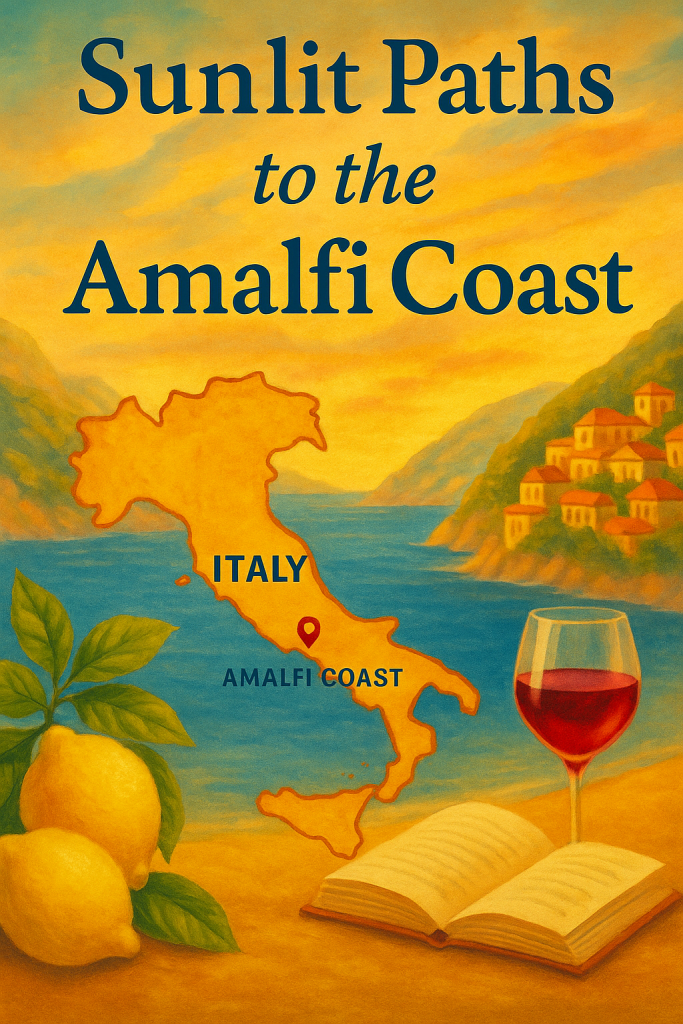
We write as Marina and Miles Ashford. Our novel, Sunlit Paths to the Amalfi Coast: A Love Story Lived, then Written, is adult second-chance travel romance with grief allowed to stay in the room. Roughly eighty percent of it grew from years we lived and walked in Italy together. The cover is a painting. Sofia Moretti and Tom Bennett are characters; the novel is not a memoir. Marina Miles Books is the imprint, not a person. This page is about search language, not a blurb dump.
We have already written a filter for choosing among Italian romance novels without a leaderboard, and a setting-craft note on what romantic novels set in Italy need from place. Those pages stay. This one answers a different question: what readers mean—often without knowing it—when they type Italian love stories at all.
What the Phrase Italian Love Stories Actually Collects
Search engines treat “Italian love stories” as a soft synonym for romance-plus-Italy. Readers treat it as a mood they cannot yet name. Some want melody and tragedy. Some want bloodline and inheritance. Some want danger with a red dress. Some want a farmhouse renovation and a second life. Some want two adults sharing a civic square that will not rearrange itself for their private weather. Those are different contracts. Calling them all Italian love stories is honest marketing and lazy taxonomy at once.
The phrase also gathers nonfiction-adjacent hungers: travel essays that feel like romance, memoir that tastes like fiction, “inspired by true events” blurbs that borrow novel heat without novel structure. Readers who land here after that wander deserve clarity. We write fiction. Lived detail informs it. We will not sell you a memoir under a romance keyword, and we will not invent awards to prove a climate.
Italian romance books and romance books set in Italy show up beside the same query for good reason. They are related lanes. They are not identical. A romance book set in Italy can still treat the country as a hotel balcony. An Italian romance novel can still borrow regional food from a stock photo. Italian love stories, as readers actually use the words, often want something more specific than “kiss, Italy, done”—even when the search box cannot say so.
Opera, Family Saga, and Crime Romance Are Different Doors
Opera and “great love” shorthand. Some readers typing Italian love stories want Verdi-adjacent grandeur: destiny, betrayal, arias of feeling. That hunger is real. It is not the same as contemporary travel romance. If your sample pages sound like a libretto synopsis, you have found that door—not ours.
Family saga. Other readers want generations, land, cousins who know too much, a table where love is negotiated as inheritance. Italian family sagas can be magnificent. They are not interchangeable with a two-person second-chance arc. When we say Italian love stories, we are not promising a clan chronicle.
Crime-family romance and dark-power fantasy. A third hunger arrives wearing sunglasses and a warning label. Crime-family romance borrows Italian place names as flavor for power and danger. Readers who want that should get honest labeling. We do not write that lane. We also do not joke about it for SEO. Civic towns and markets are enough tension without costume violence.
Villa Memoir Is Not Contemporary Travel Romance
A fourth hunger wants stone farmhouses, olive harvests, and the soft promise that place will rearrange a life. Some of those books are beautiful. Some are vacation therapy in hardcover. Readers hunting a villa-reset after Under the Tuscan Sun already know the north-and-central magnet. Southern Italy—and the travel romance we write—asks different questions of light, heat, and inconvenience. Tuscany is not a synonym for Italy, and a renovation is not automatically a love story.
Contemporary travel romance is a fifth door: two adults, real weather, and a map that costs something. That is the door we keep. Steam may arrive later in a book—ours is adult and steamy contemporary, not clean—but daily posts and this essay are not steam marketing. The search for Italian love stories in this lane is usually a request for attention, place, and dignity: two people seen in a country that keeps working.
If you are checking whether that fifth door is yours, our note on second chance romance after loss is the honest who-it’s-for page—widow and widower on the page, adult heat, not a guidebook glued to a plot.
What This House Means by Italian Love Stories
When we say Italian love stories, we mean contemporary fiction in which Italy is not a rented backdrop. We mean civic days: espresso standing at a bar, a shuttered street at midday, a piazza that does not rearrange itself for a protagonist’s arc. We mean regional food grammar—pasta that belongs to a place, markets that smell like fish and citrus, olive oil that is labor—not an interchangeable “Italian feast.” We mean grief allowed: loss that changes behavior without becoming a spa montage. We mean place as pressure: heat that ends a terrace plan, stone that stays damp, ferries and stairs that punish impatience.
That is a narrower claim than the autocomplete. It is also a clearer one. Books that empty the town for a private picnic will not sit on this shelf—however pretty the balcony. We are not ranking famous love stories. We are not retelling Romeo and Juliet. We are not publishing a “best of 2026” scrape. Those formats already flood the phrase. What we offer instead is a house definition you can test on page one: Does the town still work? Does the meal have a local argument? Does hope arrive without erasing what hurt?
Place as Pressure, Not a Hotel Balcony
Place as pressure means climate and inconvenience change plans. Southern light is not northern light. Heat thickens conversation. Wind ends a terrace. Black volcanic stone in a Sicilian street is not interchangeable with Amalfi limestone. Readers who want Italian love stories with teeth are usually asking for that cost—even when they phrase it as “romance in Italy.”
A hotel balcony can be beautiful. It cannot carry a book alone. The test we use is simple: if you remove the place names, does the scene still smell like a country? If not, the love story was never Italian except on the cover.
That pressure is why we begin Sunlit Paths in Sicily before the story moves through other Italian geographies toward the Amalfi Coast. Etna’s horizon, Motta-type civic towns, Catania markets—those are not postcard stickers. They are early pressure on Sofia and Tom. We will not invent a chapter that does not exist. Sorrento is not in the novel. We will not SEO-target places that are not ours to claim for this essay. Readers who also want grief and healing romance already know that Italy can hold private weather because public life keeps going. That is adjacent search, a different job from naming the phrase itself.
How to Read Past the Synonym Soup
Open a sample. Listen for which hunger you are actually feeding. If you want opera, say so. If you want family saga, say so. If you want crime romance, demand honest labels. If you want villa-reset memoir, buy memoir. If you want contemporary travel romance—Italian love stories in the house sense—watch whether two people share a working square or a rented backdrop.
Also watch soft lies: endless prosecco picnics, empty cliffs, lemons that never required a ladder, grief that resolves because the view was pretty. Italy can be generous. It is not a therapist with a view. Readers who keep bouncing between shelves are often one honest sentence away from the door they meant.
Where Our Book Sits—Softly
We point once, then step aside. Sunlit Paths to the Amalfi Coast is one adult second-chance / grief-and-healing travel romance among Italian love stories that keep civic days and place-pressure in the frame. Sofia and Tom learn each other while southern Italy keeps working. Heat begins in Sardinia in the novel’s arc; this post is not a scene list. If you prefer to begin with the story itself, the Kindle edition waits on Amazon.
The espresso table was not a research prop. It was a life we still refuse to sell as synonym soup. Keep the ordinary hour. Skip the famous-love leaderboard. Keep the town that will not empty the square.